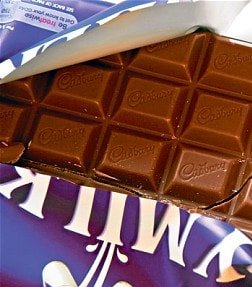
Daniel Peter from Switzerland developed milk chocolate in 1875 and four years later the first milk chocolate bar was produced.
Cadbury first added milk to eating chocolate in 1897. They weren’t the first to do it but their ‘milk chocolate’ proved to be a big seller.
By 1900 Hershey’s milk chocolate candy bar had begun the industry that would make Americans think of chocolate as something to eat.
Milk chocolate is probably the most popular of the chocolate products. It is sold directly to the consumer in a variety of solid bars or chocolate coated candy bars or other coated candies.
It is combination of chocolate liquer, additional cocoa butter, sugar milk or cream and a little vanilla.
Chocolate milk bar
The word chocolate is derived from the Aztecs names for the tree, and for the drink they prepared from the beans. These words live on in Mexican today as ‘choclatl’ for the drink and ‘cacauatl’ for the tree. Chocolate was first cultivated as a crop, by ancient Mesoamerican peoples. They used cacao beans to create a frothy chocolate drink flavored with spices.
Showing posts with label milk. Show all posts
Friday, October 27, 2017
Monday, September 02, 2013
What is milk chocolate?
Milk chocolate is made with milk powder or condensed milk and has a higher amount of sugar than dark chocolate. It also contains vanilla and lecithin.
Milk chocolate is a lighter shade because it has milk in it. It also tastes sweeter.
Milk chocolate is increasingly popular, and milk powder is still used in great quantities in the manufacture of this chocolate.
Milk ingredients are critical in delivering the highly desired properties and taste profile to consumers.
In the United States, milk chocolate must contain a minimum of 10% chocolate liquor and 12% milk solids. In Europe, milk chocolate must contain 30% chocolate liquor and 18% dry milk solids, as well as 26% total fat.
The first use of milk in a solid chocolate product is commonly attributed to Daniel Peter in 1875. He is the one of the first person to make milk chocolate.
Before this, combination of milk and cocoa solids were consumed as beverages during the eighteenth century.
What is milk chocolate?
Milk chocolate is a lighter shade because it has milk in it. It also tastes sweeter.
Milk chocolate is increasingly popular, and milk powder is still used in great quantities in the manufacture of this chocolate.
Milk ingredients are critical in delivering the highly desired properties and taste profile to consumers.
In the United States, milk chocolate must contain a minimum of 10% chocolate liquor and 12% milk solids. In Europe, milk chocolate must contain 30% chocolate liquor and 18% dry milk solids, as well as 26% total fat.
The first use of milk in a solid chocolate product is commonly attributed to Daniel Peter in 1875. He is the one of the first person to make milk chocolate.
Before this, combination of milk and cocoa solids were consumed as beverages during the eighteenth century.
What is milk chocolate?
Wednesday, November 11, 2009
Chocolate Flavored Milk
Although a variety of flavored milks (e.g., chocolate, vanilla, banana, orange, strawberry) are available locally and national, (chocolate milk is by far the most popular flavored milk).
Chocolate milk is milk to which chocolate or cocoa and sweetener has been added.
Similar to unflavored milks, chocolate milk has an excellent nutritional profile, providing significant amounts of high quantity protein, calcium, riboflavin, magnesium, phosphorus, niacin equivalent, vitamin B12, vitamin A and vitamin D, as well as several other essential nutrients.
Chocolate milk is a rich source of calcium. Each 8 once serving of chocolate milk provides 35 % of the 800 mg recommended for this nutrient for children 4 through 8, 23 % of the 1300 mg recommended for those 9 through 18 years, and 30 % of the 1000 mg recommended for adult 19 through 50.
The nutrient content of chocolate milk – whole, 1 % low fat, 2 % reduced-fat, and fat free (slim or nonfat) – is similar to that of the corresponding unflavored milk.
The main exceptions are the higher contents of carbohydrate and calories in chocolate in chocolate milk, due to the addition of sucrose and other nutrients sweeteners.
In general, chocolate flavored milks have about 60 calories more than their unflavored countered.
An 8 ounce serving of chocolate low fat (1 %) milk contains 158 calories, 2 % reduced fat chocolate milk contains 179 calories, and chocolate whole milk contains 206 calories.
Chocolate Flavored Milk
Although a variety of flavored milks (e.g., chocolate, vanilla, banana, orange, strawberry) are available locally and national, (chocolate milk is by far the most popular flavored milk).
Chocolate milk is milk to which chocolate or cocoa and sweetener has been added.
Similar to unflavored milks, chocolate milk has an excellent nutritional profile, providing significant amounts of high quantity protein, calcium, riboflavin, magnesium, phosphorus, niacin equivalent, vitamin B12, vitamin A and vitamin D, as well as several other essential nutrients.
Chocolate milk is a rich source of calcium. Each 8 once serving of chocolate milk provides 35 % of the 800 mg recommended for this nutrient for children 4 through 8, 23 % of the 1300 mg recommended for those 9 through 18 years, and 30 % of the 1000 mg recommended for adult 19 through 50.
The nutrient content of chocolate milk – whole, 1 % low fat, 2 % reduced-fat, and fat free (slim or nonfat) – is similar to that of the corresponding unflavored milk.
The main exceptions are the higher contents of carbohydrate and calories in chocolate in chocolate milk, due to the addition of sucrose and other nutrients sweeteners.
In general, chocolate flavored milks have about 60 calories more than their unflavored countered.
An 8 ounce serving of chocolate low fat (1 %) milk contains 158 calories, 2 % reduced fat chocolate milk contains 179 calories, and chocolate whole milk contains 206 calories.
Chocolate Flavored Milk
Sunday, September 27, 2009
Milk Cocoa Beverages
Dairy based products with additions of coca or chocolate are the most widely known and accepted milk drinks.
Cocoa or chocolate milk drinks are dairy based products, which are manufactured from heat treated milk with the addition of cocoa powder and sugar and eventually stabilizers. After adding the powder, the product is heat treated with and accepted process, cooled and filled.
Standard products are made from whole milk (3.5% fat content), fat reduced milk (1.5-1,.8% fat) or skim milk and are labeled in accordance with heat treatment process and the powder quality (e.g., asterisked cocoa milk, UHT chocolate milk, sterilized chocolate milk).
Additives
Additives are the different kinds of cocoa or chocolate powder which are used in the manufacturer of the milk drinks.
These powders are obtained from the press cake of the cocoa beans, where the fat or cocoa butter has been extracted by using to different degrees.
A product can be obtained which has a high to a low fat level with a fat content <10 br="">
The particle size of the powder is in range of 10 – 30 mm, and the pH is in the range of 5- 7.
Sugar (sacchrose) can be added to cocoa powder to a level of up to 65%. Other additives can be used such as vanilla, lecithin or other natural ingredients.
This powder is directly soluble in milk to a level of 20- 30%, Cocoa milk is therefore a more or less stable suspension; a part of the powder slowly settles on the bottom of the pack (due to the higher specific gravity) and is redistributed by shaking,
Homogenous distribution of the additive is a prerequisite for good taste.
By adding 1-2% of a stabilizer (=0.02-0.03 % on the finished product), the viscosity of the cocoa milk is slightly increased and the cocoa particles remain suspended.
The choice of the stabilizer depends on the selected heat treatment.
For pasteurized cocoa milk, starch, gelatin or alginates are used; for UHT products mainly carrageenan is used, and for sterilized products cellulose products, e.g., carboxymethyl cellulose (about 0.2%) is used.
For taste enhancement, additional natural or artificial flavors can be added.
Formulas 10>
<10 br="">Per liter of milk about 12-15 g of cocoa powder and 30-45 g of sugar (saccharose) is added. The formulas are made according to powder quality, taste of the product and economies.
When calculating the quantities, the different densities of milk and cocoa powder as well as the different quantities (volumes in liters for milk and mass in kg for powders) must be considered.
When adding 50 kg of sweetened cocoa powder to 1000 L of milk, we obtain 1019 liters of finished products.
Milk Cocoa Beverages10>
Dairy based products with additions of coca or chocolate are the most widely known and accepted milk drinks.
Cocoa or chocolate milk drinks are dairy based products, which are manufactured from heat treated milk with the addition of cocoa powder and sugar and eventually stabilizers. After adding the powder, the product is heat treated with and accepted process, cooled and filled.
Standard products are made from whole milk (3.5% fat content), fat reduced milk (1.5-1,.8% fat) or skim milk and are labeled in accordance with heat treatment process and the powder quality (e.g., asterisked cocoa milk, UHT chocolate milk, sterilized chocolate milk).
Additives
Additives are the different kinds of cocoa or chocolate powder which are used in the manufacturer of the milk drinks.
These powders are obtained from the press cake of the cocoa beans, where the fat or cocoa butter has been extracted by using to different degrees.
A product can be obtained which has a high to a low fat level with a fat content <10 br="">
The particle size of the powder is in range of 10 – 30 mm, and the pH is in the range of 5- 7.
Sugar (sacchrose) can be added to cocoa powder to a level of up to 65%. Other additives can be used such as vanilla, lecithin or other natural ingredients.
This powder is directly soluble in milk to a level of 20- 30%, Cocoa milk is therefore a more or less stable suspension; a part of the powder slowly settles on the bottom of the pack (due to the higher specific gravity) and is redistributed by shaking,
Homogenous distribution of the additive is a prerequisite for good taste.
By adding 1-2% of a stabilizer (=0.02-0.03 % on the finished product), the viscosity of the cocoa milk is slightly increased and the cocoa particles remain suspended.
The choice of the stabilizer depends on the selected heat treatment.
For pasteurized cocoa milk, starch, gelatin or alginates are used; for UHT products mainly carrageenan is used, and for sterilized products cellulose products, e.g., carboxymethyl cellulose (about 0.2%) is used.
For taste enhancement, additional natural or artificial flavors can be added.
Formulas 10>
<10 br="">Per liter of milk about 12-15 g of cocoa powder and 30-45 g of sugar (saccharose) is added. The formulas are made according to powder quality, taste of the product and economies.
When calculating the quantities, the different densities of milk and cocoa powder as well as the different quantities (volumes in liters for milk and mass in kg for powders) must be considered.
When adding 50 kg of sweetened cocoa powder to 1000 L of milk, we obtain 1019 liters of finished products.
Milk Cocoa Beverages10>
Monday, October 06, 2008
Modern History of Chocolate Milk
The cocoa tree is an unusual tree, with its cultivation confined to limited areas and climatic conditions. The processing required both in the areas where it is cultivated and in the factory is a complex example of human persistence and ingenuity.
Several developments have been responsible for progress in the industry, as the chocolate products as originally prepared by the natives of Central America would hardly be acceptable today. Until early 1800s the only product was a very fatty chocolate drink prepared from the whole cocoa beans, sugar, and spices.
In 1828, Van Houten of Holland invented the cocoa press, which removed a part of the cocoa fat from the bean, resulting in a powder with about 23% fat. This made the drink easier to prepare and digest. At the same time, the natural fat, cocoa butter, was released, making it possible to produce a fluid chocolate that could be molded and also used to cover other confectionary products. In England, during the 1840s, Fry and later Cadbury, made chocolate bar.
Another major development was the invention of milk chocolate by Daniel Peters of Switzerland in 1876. The ground cocoa nib (the bean cotyledon) was processed with the sugar and milk solids and the result was a product that today is the mainstay of the chocolate industry.


Cadbury’s dairy milk chocolate was developed in the early 1900s and similar products by many other manufacturer followed. Since that time, the popularity of milk chocolate has increased astronomically and with the development of mass production molding machines that have help to reduce its manufacturing cost, it is now available to almost everyone.


In the United Sates, Hershey and chocolate are synonymous. Hershey established the Hershey Chocolate Company around 1900, after selling his caramel manufacturing business. After much experimenting, he developed his own method for making milk chocolate and factory was built in the rich Pennsylvania countryside where there were plentiful of fresh milk.
The Swiss have also had a close association with the chocolate. Many of the early Swiss names cited there are still associated with chocolate products. Henri Nestlé (1814-1890) came into the chocolate industry later and was more concerned with the milk processing. Without Nestlé’s development of condensed milk, Daniel Peters would not have invented milk chocolate.
Modern History of Chocolate Milk
Subscribe to:
Posts (Atom)
The most popular articles
-
The cocoa tree is an unusual tree, with its cultivation confined to limited areas and climatic conditions. The processing required both in t...
-
Expeller cocoa butter is the fat prepared by the expeller process from cocoa beans singly or in combination with cocoa nib, cocoa mass, coco...
-
Purple beans refer to low quality beans with purple color. The main reason for purple bean is a lack of adequate fermentation. When harves...
-
The standard method for evaluating the quality of cocoa beans is a cut test on which the interior of a certain number of beans that have bee...
-
Composition of Cocoa Beans The general composition of cocoa beans from various sources is similar. With properly fermented mature beans t...