Showing posts with label chocolate bar. Show all posts

Friday, October 31, 2025

From Bean to Bar: The Modern Journey of Chocolate Making

The manufacturing of chocolate bars is a fascinating process that transforms raw cocoa beans into one of the world’s most beloved treats. Combining traditional craftsmanship with modern automation, each stage of production contributes to the distinctive flavor, aroma, and texture that make chocolate so irresistible.

The process begins with harvesting and fermenting ripe cocoa pods, usually by hand. Farmers open the pods and scoop out the beans surrounded by a sweet white pulp. These beans are piled or placed in wooden boxes to ferment for several days. Fermentation is essential—it triggers chemical changes that develop the chocolate’s complex flavors while reducing bitterness and astringency.

Next comes drying, often done under the tropical sun. The beans are spread out on drying mats or trays and turned regularly to ensure even drying. When their moisture content falls to about 7.5%, the beans are stable enough for transport to chocolate factories around the world.

In the factory, roasting deepens the chocolate’s flavor. Beans are roasted at carefully controlled temperatures, typically between 120°C and 150°C. This step enhances aroma through chemical reactions like the Maillard reaction and helps loosen the outer shells.

After roasting, the beans go through cracking and winnowing, which separate the edible cocoa nibs from their papery husks. The nibs then move to grinding, where they are crushed into a thick, glossy liquid known as chocolate liquor. Despite its name, this liquid contains no alcohol—it’s simply melted cocoa solids suspended in cocoa butter.

During mixing and refining, ingredients such as sugar, milk powder, and extra cocoa butter are added. The mixture passes through fine rollers that reduce particle size to create a velvety texture. The refined mass is then conched, a process that stirs and aerates the chocolate for hours or even days to smooth the flavor and aroma.

The next step, tempering, is a precise heating and cooling process that forms stable cocoa butter crystals, giving chocolate its shiny surface and signature “snap.” Finally, the chocolate is molded, cooled, and packaged under strict quality control—ready to delight chocolate lovers everywhere.

From tropical farms to factory molds, every step in chocolate making reflects both art and science—turning simple cocoa beans into pure indulgence.
From Bean to Bar: The Modern Journey of Chocolate Making

Wednesday, April 13, 2022

Kit Kat chocolate bar

Originally four finger version, Kit Kat is a perfect balance of chocolate and wafer first launched in the UK in 1935 as ‘Rowntree's Chocolate Crisp'. The Kit Kat brand name and logo was introduced on pack in 1937.

The two-finger version was launched in 1936. It was renamed Kit Kat Chocolate Crisp in 1937, and just Kit Kat after World War II. Since then, it has consistently been one of the best-selling chocolate bars on the market and has acquired an instantly recognizable brand name and identity.
International expansion of the brand starting in 1950s in Commonwealth countries, such as Australia, New Zealand, South Africa, Rhodesia and Canada, where Rowntree already had an established base

The famous Have a break, have a KitKat strapline was first used in 1958 and has been used without a 'break' ever since. Kit Kat can be considered as a snack between a chocolate bar and a biscuit. It has around layers of wafer’ chocolate cream and a milk chocolate coating.

Its form of four finger format makes the chocolate easily divided for eating, sharing and make it last longer.
KitKat chocolate bar

Friday, October 27, 2017

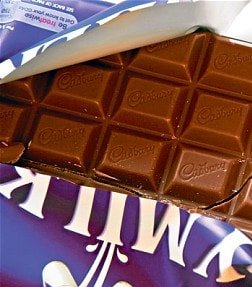
Chocolate milk bar

Daniel Peter from Switzerland developed milk chocolate in 1875 and four years later the first milk chocolate bar was produced.

Cadbury first added milk to eating chocolate in 1897. They weren’t the first to do it but their ‘milk chocolate’ proved to be a big seller.

By 1900 Hershey’s milk chocolate candy bar had begun the industry that would make Americans think of chocolate as something to eat.

Milk chocolate is probably the most popular of the chocolate products. It is sold directly to the consumer in a variety of solid bars or chocolate coated candy bars or other coated candies. It is combination of chocolate liquer, additional cocoa butter, sugar milk or cream and a little vanilla.
Chocolate milk bar

Sunday, December 13, 2015

Chocolate bar invention by Fry & Sons

Chocolate was primarily served as a drink or an ingredient in recipes until 1847.

Back in 1830, British candy makers J.S Fry and Sons developed the world’s first chocolate bar by roasting fermented cacao pods and then grinding them into a fine paste that could be separated into either cacao solids or cocoa butter.

J. S. Fry & Sons Limited was owned by Joseph Storrs Fry and his family. The company experimented with the ‘Dutched’ chocolate adding sugar and some of the cocoa butter and molding the mixture. They produced and commercialized the first plain chocolate bar in 1847 meant for eating as a snack.

Fry & Sons advertised it as ‘Chocolat Delicieux a manger’ (or Chocolate delicious to eat). In 1861 Richard Cadbury creates the first know heart-shaped chocolate box for Valentine’s Day.

The company later merged with Cadbury to form Fry Cadbury in 1919.
Chocolate bar invention by Fry & Sons

Wednesday, January 14, 2015

Ingredients in chocolate milk bar

Chocolate liquor, pure fluid whole milk and powdered sugar are the basic ingredients for milk chocolate bar.

The proportion of cocoa liquor in the final product determines how dark the chocolate is. From a nutritional standpoint the darker a chocolate is, the better because it contains a higher percentage of cocoa.

To prepare chocolate bars, the cocoa powder is mixed with other ingredients (sugar, milk, nougat, vanilla flavor); the mixture is refined and freed from lumps; it is then ripened at different temperatures.

Vanilla flavor is the most common basic flavoring to be mixed into the chocolate mixture. It is obtained by using vanillin.

The mixture is then passed through a series of large steel roll refiners, where an intense shearing and rubbing action reduces the mass to a uniform paste that is so smooth that the coarse particles will be less than 50 u in size.

Chocolate bars and candy can be filled with flavored fondants, liquor-soaked fruit, dry, roasted, or candied, liquors, etc. Milk chocolate is creamy but the added milk also adds calories and fat.
Ingredients in chocolate milk bar

The most popular articles

Other interesting articles

  • Gelatin is one of the most versatile, multi-functional ingredients in the modern food industry. At its core, gelatin is a tasteless, odorless polymeric p...
  • The *Auspicious Incident* (*Vaka-i Hayriye*) refers to the dramatic destruction of the Ottoman Janissary corps by Sultan Mahmud II on June 15, 1826. Thou...